
Table of Contents
ToggleSmart Money Concept (SMC) Basic To Advance
Author
sunnybullsacademy@gmail.com
Published
June 8, 2026
Category

Smart Money Concept (SMC) Basic To Advance 2026
The financial market is not moved randomly. Behind every major move in the market, there are institutional players like banks, hedge funds, market makers and smart money participants controlling liquidity and price delivery. Most retail traders lose money because they trade without understanding how institutional trading really works.
This is where the Smart Money Concept (SMC) becomes powerful.
Smart Money Concept is one of the most advanced price action trading methodologies used by modern traders to understand market structure, liquidity, order flow and institutional behaviours. Unlike traditional indicators that lag behind price, SMC trading focuses on how smart money manipulates liquidity and creates high-probability trading opportunities.
In this complete beginner-to-advanced guide, you will learn:
- What Smart Money Concept is?
- How institutional traders move the market?
- Market structure and liquidity concepts
- BOS and CHOCH explained .
- Order blocks and Fair Value Gaps (FVG) .
- Liquidity sweeps and stop hunts.
- Premium and discount zones .
- Multi timeframe analysis .
- Risk management and trading psychology .
- Advanced SMC trading strategies .
Whether you trade the Forex market, stock market, crypto market or indices, understanding Smart Money Concept can help you improve your trading decisions using institutional order flow and market structure analysis.
What is Smart Money Concept (SMC)?
Smart Money Concept (SMC) is an advanced trading methodology based on institutional trading behaviours. It helps traders understand how banks, hedge funds, market makers and institutional investors manipulate liquidity and move the market.
The core idea behind SMC trading is simple:
The market moves from liquidity to liquidity.
Institutional traders need massive liquidity to enter and exit positions. Because of this, they often push price toward areas where retail traders place stop losses and pending orders.
This process creates:
- Liquidity grabs
- Stop hunts
- Fake breakouts
- Market manipulation
- Trend reversals
Smart Money Concept helps traders identify these institutional footprints using:
- Market structure
- Liquidity analysis
- Order blocks
- Fair value gaps
- Price delivery imbalance
- Institutional order flow
Unlike traditional technical analysis, SMC focuses on understanding why price moves instead of simply reacting to indicators.

How Smart Money Works in Financial Markets
The financial market is controlled largely by institutional traders because they trade huge volumes of money.
These institutional participants include:
- Banks
- Hedge funds
- Market makers
- Institutional investors
- Smart capital firms
Retail traders usually enter trades emotionally, while institutional traders focus on:
- Liquidity
- Order flow
- Market efficiency
- Risk management
- Engineered price movement
Smart money often manipulates the market to collect liquidity before the real move begins.
For example:
- Retail traders buy breakouts
- Institutions push price slightly higher
- Retail stop losses accumulate
- Smart money sweeps liquidity
- Price reverses aggressively
This is called a liquidity sweep or stop hunt.
Understanding these concepts gives traders a major advantage in the Forex market, stock market and crypto market.
Smart Money vs Retail Traders
Smart Money Traders | Retail Traders |
Trade using liquidity | Trade emotionally |
Understand market structure | Follow indicators blindly |
Use institutional order flow | Chase breakouts |
Focus on risk management | Overtrade |
Trade with patience | Fear and greed dominate |
Use multi timeframe analysis | Ignore higher timeframe bias |
Most retail traders lose because they trade against institutional order flow.
SMC trading helps align trades with smart money instead of fighting against it.
Market Structure Explained
Market structure is the foundation of Smart Money Concept trading.
Without understanding market structure, it becomes impossible to identify trend continuation, trend reversal and institutional market behaviours.
Market structure consists of:
- Higher High (HH)
- Higher Low (HL)
- Lower High (LH)
- Lower Low (LL)
An uptrend forms when price creates:
- Higher highs
- Higher lows
A downtrend forms when price creates:
- Lower highs
- Lower lows
Understanding market structure helps traders identify:
- Trend direction
- Momentum
- Reversal zones
- Institutional activity
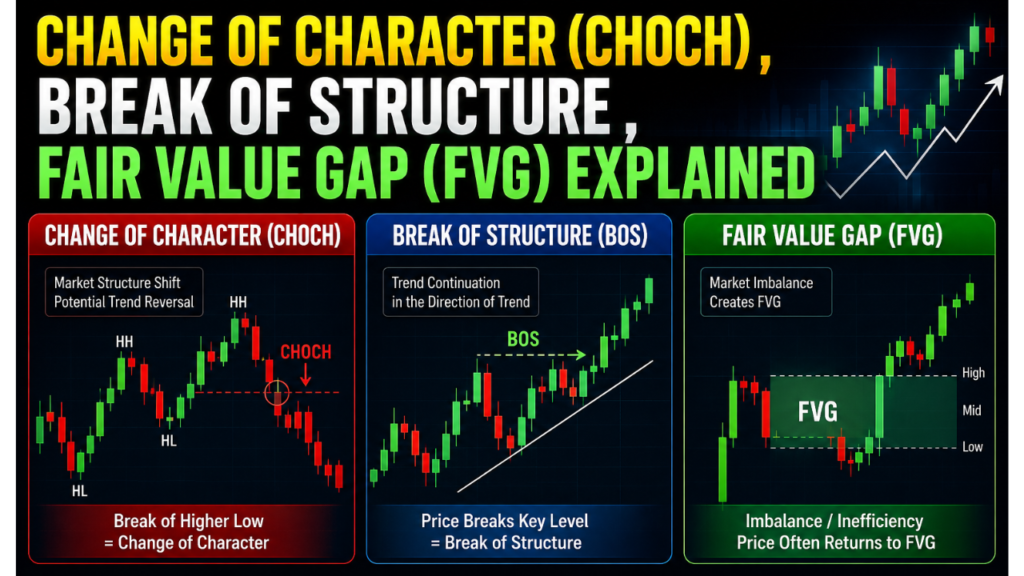
Break of Structure (BOS)
Break of Structure (BOS) happens when price breaks a previous significant high or low in the direction of the trend.
In bullish market structure:
- Price breaks previous highs
- Indicates bullish continuation
In bearish market structure:
- Price breaks previous lows
- Indicates bearish continuation
BOS confirms trend strength and institutional participation.
Traders use BOS for:
- Trend confirmation
- Entry confirmation
- Continuation setups

Change of Character (CHOCH)
CHOCH stands for Change of Character.
It signals a possible trend reversal.
For example:
- Market forms higher highs and higher lows
- Suddenly price breaks a higher low
- This indicates possible bearish reversal
CHOCH is important because:
- It identifies early reversals
- Shows shift in market sentiment
- Helps detect institutional repositioning
Most advanced SMC traders combine BOS and CHOCH with liquidity and order blocks for higher probability trades
Liquidity in Smart Money Concept.
Liquidity is one of the most important concepts in SMC trading.
Liquidity refers to areas where large numbers of orders exist.
Institutional traders target these liquidity zones because they need large order flow to execute trades.
Main types of liquidity:
- Buy Side Liquidity.
- Sell Side Liquidity.
Buy Side Liquidity.
Buy side liquidity exists above highs where retail traders place:
- Buy stop orders.
- Stop losses for sell positions.
Smart money often pushes price above highs to capture liquidity before reversing.
This creates:
- Liquidity grabs.
- Fake breakouts.
Stop hunts.
Sell Side Liquidity
Sell side liquidity exists below lows where traders place:-
- Sell stop orders
- Stop losses for buy positions
Institutions often sweep these lows before moving price upward.
Liquidity Sweep Explained.
A liquidity sweep happens when price aggressively moves into liquidity zones to trigger stop losses and pending orders.
After collecting liquidity:
- Price often reverses strongly
- Institutional traders enter large positions
Liquidity sweeps are extremely common during:-
- London session
- New York session
- High-impact news events
This is why understanding liquidity trading is essential in Smart Money Concept.
Equal Highs and Equal Lows
Equal highs and equal lows are major liquidity zones.
Retail traders often see:
- Equal highs as resistance
- Equal lows as support
Institutional traders see them as liquidity pools.
Price frequently sweeps equal highs or equal lows before making the actual move.
Order Block Explained
Order blocks are institutional zones where banks and smart money place large buy or sell orders.
A bullish order block forms before a strong upward move.
A bearish order block forms before a strong downward move.
Order blocks help traders identify: –
- Institutional entry zones
- High probability reversals
- Continuation setups
Types of order blocks: –
- Bullish Order Block
- Bearish Order Block
- Mitigation Block
- Breaker Block
- Institutional Order Block
Valid vs Invalid Order Blocks
A valid order block usually has: –
- Strong displacement
- Liquidity sweep
- BOS confirmation
- Fair value gap nearby
An invalid order block: –
- Lacks momentum
- Has weak market structure
- Gets broken immediately
Understanding valid order blocks improves trading accuracy significantly.
Fair Value Gap (FVG) Explained
Fair Value Gap (FVG) is one of the most important SMC concepts.
A Fair Value Gap forms when price moves aggressively, creating imbalance or inefficiency in the market.
This imbalance often gets revisited because markets seek efficiency.
FVG trading is used for: –
- Trade entries
- Continuation setups
- Institutional retracement zones
Fair Value Gaps work best when combined with: –
- Order blocks
- Liquidity sweeps
- Market structure
BOS confirmation
Market Imbalance and Price Delivery
Institutional traders create imbalance using aggressive buying or selling pressure.
This causes: –
- Displacement
- Inefficient price delivery
- Fair value gaps
Markets often retrace into these imbalance zones before continuing the trend.
This concept is known as: –
- Price Delivery Imbalance
- Market Inefficiency
- Institutional Repricing
Premium and Discount Zone
Premium and discount zones help traders identify whether price is expensive or cheap.
Using Fibonacci retracement: –
- Premium zone = expensive price
- Discount zone = cheap price
Institutional traders prefer: –
- Selling from premium zones
- Buying from discount zones
This concept improves: –
- Risk reward ratio
- Entry precision
Sniper entries
Optimal Trade Entry (OTE)
OTE stands for Optimal Trade Entry.
It combines: –
- Fibonacci retracement
- Market structure
- Liquidity
- Institutional trading concepts
Most SMC traders use:
- 62%
- 70.5%
- 79%
retracement levels for high probability entries
Multi Time Frame Analysis
Multi timeframe analysis is critical in Smart Money Concept trading.
Professional traders’ analysis : –
- Higher timeframe bias
- Lower timeframe execution
Example: –
- Daily chart identifies trend
- 4H chart identifies structure
- 15M chart provides entry
This improves: –
- Trade accuracy
- Risk management
Institutional alignment
Best SMC Trading Strategy
A simple SMC trading strategy may include: –
Step 1 — Identify Market Structure
Determine bullish or bearish structure.
Step 2 — Mark Liquidity Zones
Identify equal highs, equal lows and resting liquidity.
Step 3 — Wait for Liquidity Sweep
Allow institutions to grab liquidity.
Step 4 — Look for CHOCH or BOS
Wait for market confirmation.
Step 5 — Enter from Order Block or FVG
Use institutional zones for precise entry.
Step 6 — Manage Risk
Maintain proper risk reward ratio.
This strategy helps traders avoid emotional trading and follow institutional order flow.
Trading Psychology in SMC
Even the best strategy fails without proper psychology.
Most traders lose because of: –
- Fear
- Greed
- Revenge trading
- Overtrading
- Lack of discipline
Professional traders focus on: –
- Risk management
- Patience
- Consistency
- Emotional control
Smart Money Concept is not just about charts — it is also about mindset and discipline
Risk Management in Smart Money Trading
Risk management is more important than strategy.
Never risk large capital on a single trade.
Important rules: –
- Risk only 1–2% per trade
- Use stop loss
- Maintain positive risk reward ratio
- Avoid overleveraging
- Follow trading discipline
Without proper risk management, even profitable traders eventually fail.
Common Mistakes in Smart Money Concept Trading
Many beginners make these mistakes: –
- Trading every order block
- Ignoring higher timeframe trend
- Entering before confirmation
- Trading during low liquidity
- Poor risk management
- Chasing liquidity aggressively
- Ignoring market structure
Avoiding these mistakes improves long-term profitability.
SMC vs Traditional Price Action
Smart Money Concept Traditional Price Action
Focuses on liquidity | Focuses on patterns |
Institutional order flow | Retail perspective |
Uses BOS and CHOCH | Uses support/resistance |
Advanced market logic | Simpler analysis |
Emphasizes liquidity sweeps | Emphasizes breakout trading |
Both approaches can work, but SMC provides deeper understanding of institutional market behaviour.
SMC vs ICT Concepts
Many traders confuse SMC and ICT concepts.
ICT (Inner Circle Trader) concepts are a major influence behind modern Smart Money Concept trading.
Common ICT concepts include: –
- Liquidity pools
- Fair value gaps
- Market maker model
- Premium and discount arrays
- SMT divergence
- Time and price theory
Modern SMC strategies are heavily inspired by ICT methodologies.
Advanced Smart Money Concepts
Once traders master the basics, they can explore advanced concepts like: –
- SMT Divergence
- Session Trading
- London Kill Zone
- New York Session Trading
- Reaccumulation
- Redistribution
- Institutional Candle Theory
- Market Maker Model
- Liquidity Engineering
These advanced concepts help traders understand deeper institutional manipulation.
Best Timeframes for SMC Trading
The best timeframe depends on trading style.
Trading Style Best Time frame
Scalping | 1M – 5M |
Intraday Trading | 5M – 15M |
Swing Trading | 1H – Daily |
Position Trading | Daily – Weekly |
Higher timeframes generally provide stronger market structure and cleaner liquidity zones.
Can Beginners Learn Smart Money Concept?
Yes, beginners can learn Smart Money Concept, but it requires patience and screen time.
Start with: –
- Market structure
- Liquidity
- BOS and CHOCH
- Order blocks
- Fair value gaps
Avoid jumping directly into advanced ICT concepts.
Master the basics first.
Is Smart Money Concept Profitable?
Smart Money Concept can be profitable when combined with: –
- Discipline
- Risk management
- Backtesting
- Patience
- Multi timeframe analysis
However, no strategy guarantees profits.
The market is unpredictable and traders must continuously improve their understanding of price action and institutional behaviour.
Final Thoughts
Smart Money Concept is one of the most powerful trading methodologies in modern financial markets. It helps traders understand institutional order flow, liquidity engineering, market structure and price delivery mechanisms used by banks and smart money participants.
Unlike traditional indicator-based systems, SMC trading focuses on understanding why the market moves and where liquidity exists.
If mastered properly, Smart Money Concept can help traders:
- Improve market understanding
- Avoid retail trading mistakes
- Increase trading precision
- Trade with institutional logic
- Build consistent trading discipline
The key is not memorizing concepts but understanding how smart money manipulates liquidity and market structure across different market conditions.
Successful trading requires: –
- Practice
- Patience
- Risk management
- Emotional discipline
- Continuous learning
The deeper you understand liquidity, order flow and institutional behaviour, the better your ability to read the market like professional traders.
Frequently Asked Questions (FAQ) — Smart Money Concept (SMC) Basic To Advance
What is Smart Money Concept (SMC) in trading?
What does BOS mean in Smart Money Concept?
Do I need to renew my license?
What is CHOCH in trading ?
What is liquidity in SMC trading?
What is a liquidity sweep?
What is an order block in SMC?
What is Fair Value Gap (FVG)?
Which timeframe is best for - Smart Money Concept?
Is Smart Money Concept profitable?
What is the best SMC trading strategy?
What indicators are used in Smart Money Concept?
How to Change my Photo from Admin Dashboard?
Trading Disclaimer
Trading and investing involve substantial financial risk. This content is for educational purposes only and should not be considered financial or investment advice. Always perform your own research and risk management before trading in financial markets